
Pablo Neruda’s dining room
July 3, 2015 § Leave a comment

Pablo Neruda’s dining room at Isla Negra
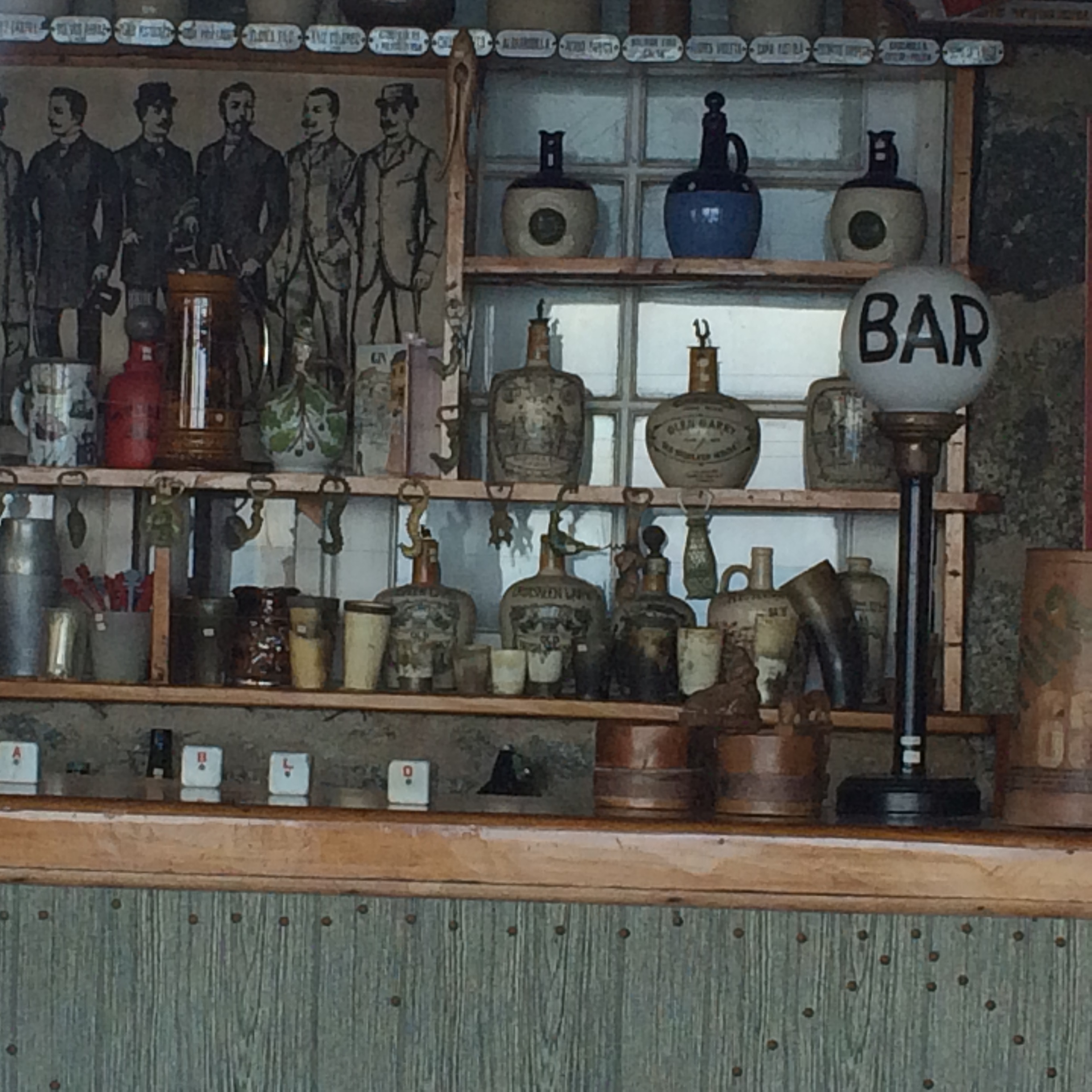
& bar

Working in the Dark: Homage to John Thompson
February 12, 2015 § 1 Comment
If I’d come here in early spring I might
have divided Thompson’s plant, and dug it in
in the midst of this poem, that years from now it might remain, out-competing
my rhubarb words, holding its green salvers to the sun–from “Barbarians,” Amanda Jernigan
“Spring rain, releasing the mist of dung from the opening soil to hang thick in the still air, to cling to the furry hooks of cloth and skin; the sweet smell of rot; and that other smell, the smell of green, the taste of pure white working into the tongue, young onions, roots growing from his wife’s hands, mingling oils, hands and roots bearing the same beads of black dirt, the same beads of rainwater; human, womanly roots tangling in his body, her shape looming, enlarging over him, a greenness, a whiteness, bearing the must of soil, drawing him up into energy.”
–from “Chapter One,” John Thompson
Last month I managed at last to find a copy of John Thompson’s Stilt Jack that I could afford — a library discard from the University of California at Riverside (why would they ever want to discard this book??). It’s still fairly well preserved, possibly never read in fact, stapled within stiff cardboard sleeves. I have to decide whether to extract it (I think I can do it and leave the original quite intact) or leave it be — it’s the kind of talismanic book I’ll end up carrying around everywhere, and the cardboard might offer some protection.
Around the same time, Peter Sanger was kind enough to send me a copy of Working in the Dark: Homage to John Thompson, recently published by Anchorage Press: a portfolio of photographs of Jolicure (where Thompson lived for a time) by Thaddeus Holownia, who owns the press, along with accompanying archival materials and elegies for Thompson, written by contemporary poets. Peter’s introduction to it also offers some new details about Thompson’s connections to his property in Jolicure, and describes some of the new Thompson materials that were left in his English Department office after his death, recently archived at Mount Allison University.
This is a beautiful book, that takes as its focus the land and house that Thompson owned in Jolicure. He lived there for only a short time — as Peter describes it, for only one season of the rhubarb patch, all that survives of Thompson’s original garden. The seven elegies in this book (I’ve included an excerpt of Amanda Jernigan’s, above), take this rhubarb patch as meditative focus, and it’s interesting to see how each poet makes the subject his or her own, from echo of 16th century lyric to 19th century seed catalogue (Rob Winger’s contribution). Amanda Jernigan’s elegy, for example, hinges on Philip Sidney’s lines, “Alas, I have not pain enough, my friend…But with your rhubarb words you must contend/To grieve me worse, in saying….” Yet, similarities also run through the elegies, like a mineral vein.
In his introduction to the photographs and poems, Peter notes, with regards to the rhubarb patch:
A few minutes walk up the road from the cemetery was the fire-blackened, rock-walled cellar hole of Thompson’s house, with the surviving metal wreckage. The two surviving barns became increasingly skewed by wind, frost and rot until they finally fell. The site became feral land, covered in weeds, wild rose bushes, sheep laurel and rhubarb — the rhubarb plot persisted, a contradictory, resilient mix of the wild and domestic. A Thompson poem of sorts.
Working in the Dark also includes a previously unpublished typescript of a prose poem by Thompson, called “Chapter One,” from which I’ve included an excerpt above, and beautiful, stark black and white photographs of the woods in Jolicure, taken by Holownia, who now owns the property: branches with a skin of snow, a stand of luminescent birch trees.
The title comes from an abandoned version of the preface to Stilt Jack: “I’ve been working in the dark with the poems — but why not?”

notes on summer ghazals
June 30, 2014 § 2 Comments
1. resist the urge to write couplets that connect one to the other
2. but total randomness doesn’t work either
3. give in to the urge to write couplets that connect one to the other
4. or at least, give in to the semiotic — rhythm, rhyme, recurring patterns of sound
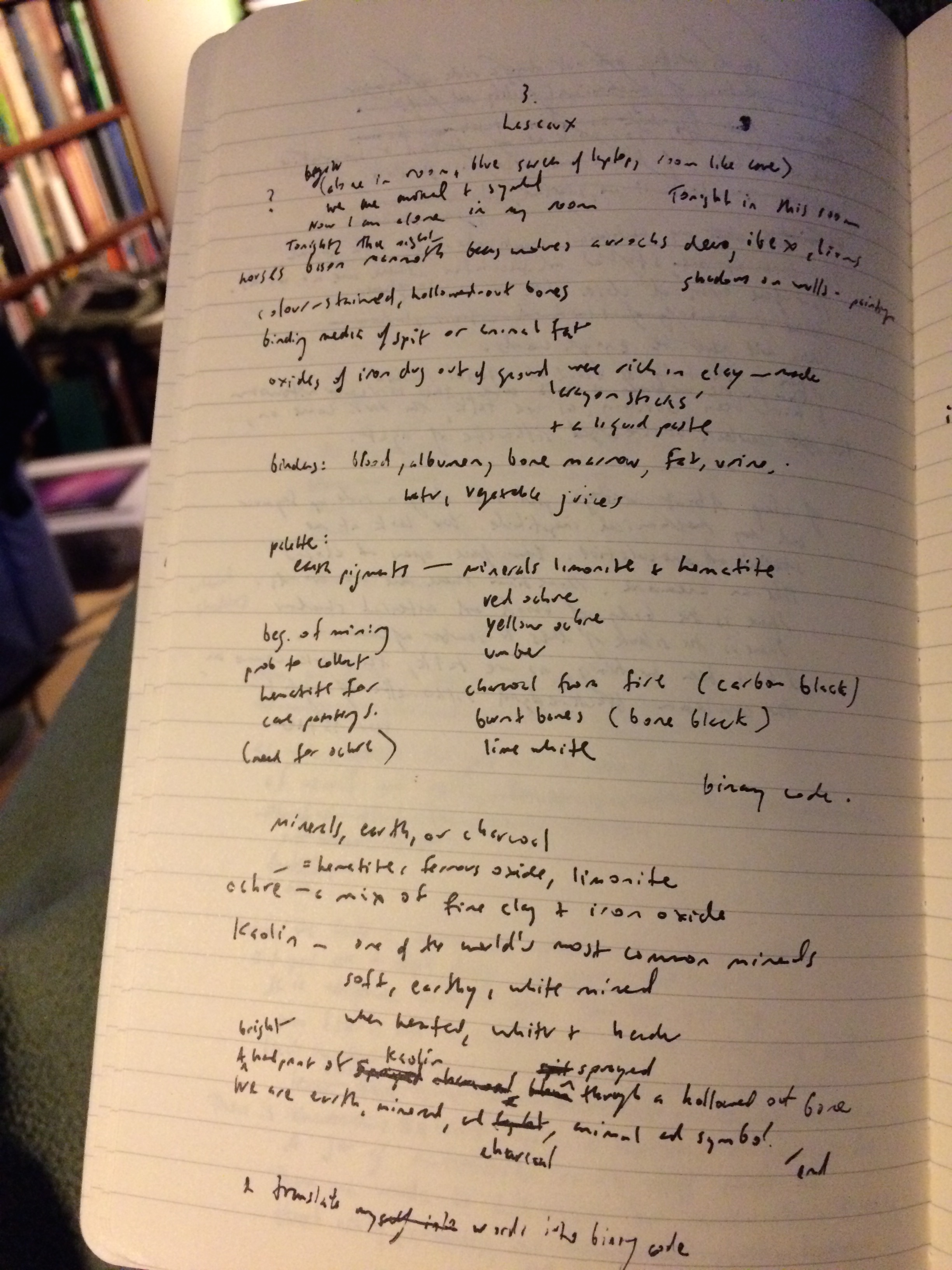
5. someone told me yesterday there’s a boy in a cave in Spain, writing poetry
6. each couplet is a pair of nucleic acids, GC, AT: one completes the other
7. secular desire is encoded as sacred, and vice versa
8. once you begin, it is difficult to stop (bastard ghazal, north american ghazal, not really a ghazal, ghost). it is a serious addiction
9. anything might enter a ghazal, like the tiny wasp with copper wings that has landed on my knee, or everyone who comes to this park to smoke pot except me
10. this list has elements of a ghazal. this is not a ghazal
“desire that remains desire”: on the ghazal pt.5
March 31, 2014 § Leave a comment
Poetry: desire that remains desire. Love?
The poet: a cinder never quite burned out.
–John Thompson, Ghazal XIV, Stilt Jack
This can’t be more than a footnote to my earlier posts on the ghazal as I’m overrun just now. But Im reading on my endless bus trips to and from campus, and enjoying immensely (the book, not the bus, where I think I’m beginning to show signs of Bus Traumatic Stress Disorder), the poet Peter Sanger’s Sea Run: Notes on John Thompson’s Stilt Jack. (Xavier Press, 1986). It’s a meticulous line by line commentary on Thompson’s Stilt Jack, and has also confirmed some of the haphazard thoughts I’ve had about the ghazal–most specifically, that as a form it isn’t as random as initial impressions suggest. I include one example here of Sanger’s notes on the above couplet from “Ghazal XIV.”
“This couplet quotes from Jackson Mathew’s translation of Sections XXX and V of Char’s ‘Partage Formel’. Thompson uses Mathew’s translations in his thesis: (a) A poem is the realization of love — desire that remains desire; (b) The poet, a magician of insecurity, can have only adopted satisfactions. A cinder never quite burned out. Thompson intended these quotations as a tribute to Char and expected readers to uncover their source. Any question of propriety becomes more complex when one considers, as Thompson probably knew, that Char’s source in quotation (b) above was probably a passage in A Defence of Poetry where Shelley describes Dante, whose very words are instinct with spirit; each is as a spark, a burning atom of indistinguishable thought; and many yet lie covered in the ashes of their birth, and pregnant with the lightning which has yet found no conducter.” p.21
It’s one of my favourite couplets from Stilt Jack, and the commentary works as a kind of archaeological excavation, revealing layers of complexity and allusion, line under line.
stray notes on the ghazal (pt. 3)
January 2, 2014 § Leave a comment
1. The ghazal, as it has taken root in North America (the free verse ghazal, the ‘bastard’ ghazal, the ‘anti-ghazal’) privileges randomness, the disunity and illogicality of the couplets, as a release from thematic unity. Formal adherence to the radif might create, if done well, necessary tension — a pull against the random.
2. Pound’s ideogrammic method is at work: Iron rust. Rose. Cherry. Flamingo. Both within and across couplets.
3. And Eliot’s objective correlative: “The only way of expressing emotion in the form of art is by finding an ‘objective correlative’; in other words, a set of objects, a situation, a chain of events which shall be the formula of that particular emotion; such that when the external facts, which must terminate a sensory experience, are given, the emotion is immediately evoked.”
4. Lists take precedence:
“Crazy squash, burnt tomatoes, char of poems, sour milk,
a candle gone down: is this my table?” (Stilt Jack VII)
5. Andy Weaver describes the importance of the gap between couplets. This is crucial. A musical and conceptual interval or gauge, which must be finely judged by the poet, and for which there can be no rules.
6. Weaver also describes his experience of writing ghazals as analogous to carpentry. Couplets like driftwood he collects and then fits together. Perhaps gathering works here too. What is found in the world is gathered and held in couplets like baskets.
7. Webb uses internal rhyme and initial/terminal homonyms and homophones as ghostly echo of the qafia and radif. Here/hear. Leaves/leaves. Time/time.
8. What is truly desired is language. Language registers absence.
The beloved is a woman, is a man, is a body of language.
9. The ghazal as field notes, as transcription: each couplet the trace of a single moment.
10. These moments are plotted on an emotional plane. Paradigmatic axis (individual couplets); syntagmatic axis (their cumulative effect; a kind of jagged, dreamlike syntax).
11. The bass note is grief.
 kim trainor