KIM TRAINOR: A PLANET EARTH POETRY INTERVIEW (November 2nd, 2024)
February 4, 2025 § Leave a comment
I’m delighted to post (albeit belatedly) this thoughtful interview by poet Anna Cavouras of Planet Earth Poetry, an amazing reading series based in Victoria, British Columbia. Anna and I share similar ecological and poetic interests, and it was lovely to chat with her late last year before my reading at PEP 😀
Anna Cavouras: What calls you to use poetry to talk about climate collapse?
Kim Trainor: I guess we use the tools that are to hand. For me, those tools are poetry, poetry films, and, when I’m in a teaching semester, my classes. When it comes to poetry, my poetry documents my life and it is inevitable then to include everything this encompasses, including climate collapse, the sixth mass extinction, the breaching of planetary boundaries, and so on. But such massive damage might be refracted in a poem in the smallest ways—a recollection of how caterpillars used to be everywhere as a child; snowdrops blooming earlier each year, finding new phrases suddenly come effortlessly to the tongue, like ‘atmospheric river’ or ‘polar vortex’ or ‘heat dome.’
AC: Poetry exceeds words in this collection. How would you describe the role that other mediums, (tech drawings, emails, sketches), play in this collection?
KT: There are a lot of mediums in my book—Gmails, a blueprint drawing for the Svalbard seedbank, sketches of chloroplasts, a child’s drawing of a monster, a photograph I took of a bumblebee, fuzzed with pollen. I’ve always been interested in how lyric poetry might move beyond traditional collections, without sacrificing the intimacy, emotionality, and music of the lyric. So I’m borrowing techniques from documentary poetry, constraints, data, prose-poems, collage but still trying to stay true to my roots.
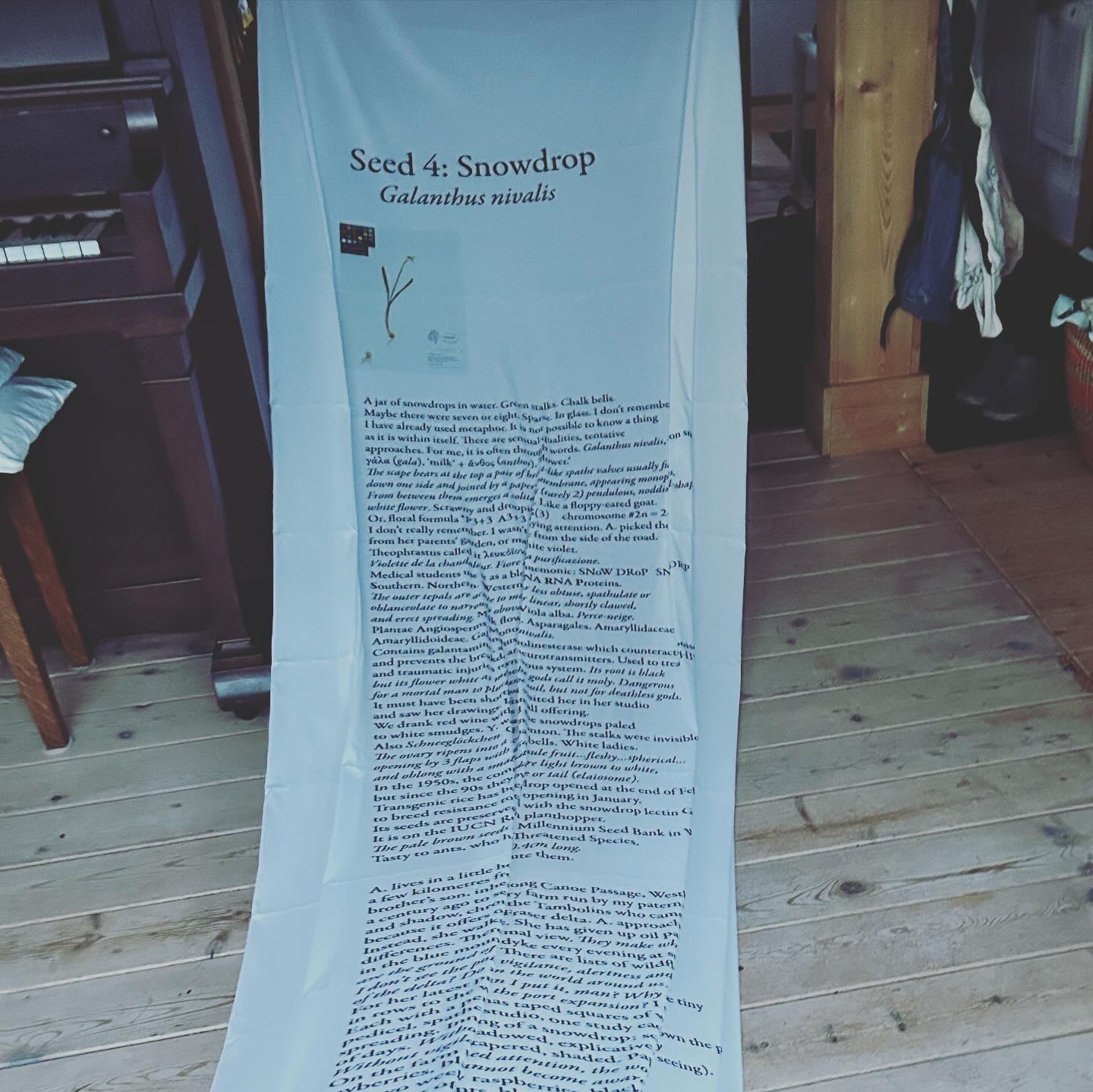
The first section of A blueprint for survival is traditionally lyric, while the second section, called “Seeds,” is where the various mediums appear, often embedded within a diary format—excerpts from news articles, IG posts, etc. These diary entries run along the bottom of every page in the second half of the book, while the ‘seeds’ or poems appear above; the 2-part division could be thought of as soil with offshoots; mycelia with trees: the seeds of poems draw sustenance from this fertile soil. The diary documents the process of writing poetry and illustrates how what happens in daily life is what gives rise to individual poems. The photographs and diagrams are part of this documentary aspect, and I also wanted to visually depict multivocality and the kind of sympoiesis or co-making that I think we need to be aware of moving forward.
As humans we have evolved to become an apex super-species that predates on every other living being while strip-mining the planet. We need to learn how to co-exist, live with less, care more, understand that all organisms are in a process of world-making.
AC: In the second part of the collection, “Seeds”, you describe the examples (lentil, tardigrade, snowdrop, etc.) as “blueprints”. They feel like really thoughtful choices. I would love to know more about the process of choosing these specific examples over others. and how these examples strengthen the collection.
KT: At the back of my mind was a comment made by James Lovelock in his Revenge of Gaia (2006), which I paraphrase in A blueprint for survival in the “Codex” seed: “James Lovelock …called for the creation of a simple book, a primer that survivors of an existential global event might use to rebuild a more peaceful, hopefully more sustainable, world. It would contain basic hard-won knowledge—of elements and microbes, of atoms and childbirth, of hygiene and crucial medicines, of how to collect and sow seeds. He suggested it should be printed on acid-free pages, in colour-fast ink, collected in a well-stitched codex and written in a language so beautiful that every home would have one on the shelf so that its ubiquity might guarantee its survival.” I was thinking more expansively in “Seeds”—how not just scientific knowledge might serve in aiding survival (not only human but survival of all species), or how such a codex might assist, but also how other organisms have found ways of world-making and adapting.
For “Hymenoptera (honeybee, bumblebee, Vespa orientalis)” I was intrigued by Robert Bringhurst’s reference to the Vespa orientalis in his essay in Learning to Die (2018); this wasp has learned to harvest energy directly from sunlight; its cuticle is formed of yellow xanthopterin and brown melanin, both of which absorb light.
“Tardigrade” was inspired by a news article on the Israeli Beresheet rocket (named after the opening word of Genesis in the Hebrew bible, ‘In the beginning’). It crash-landed on the moon with a payload that included what was described as an archive of curated human knowledge etched by lasers onto 25 stacked nickel discs, some of which could be read by the human eye, others only by microscope or magnifying glass. The archive comprised the entire English Wikipedia and a wearable Rosetta disc, a primer to the world’s languages. The nickel discs could resist oxidization, wouldn’t degrade, were immune to microbes, chemical erosion, and extreme cold. The library was meant to be a “backup for humanity,” and, if it survived the crash landing on the moon, might have a shelf life of 10,000 years or more; several billion in the vacuum of space. The payload also included a handful of tardigrades in their dormant tun state, in which they are virtually indestructible, even in the void of space. They seem like a remarkable and cheeky species, in the face of venture capitalists and human hubris. There’s a little story behind each seed but those are some examples.
AC: On page 140, you discuss the idea of attention as a “moral act”—what role do you see poets have in this attention? What role does A blueprint for survival play?
KT: The botanist and writer Robin Wall Kimmerer, in Gathering Moss, 2003, describes attention as a form of intimacy—a receptiveness to learning, to hearing stories and perspectives of others, other organisms, other kin, the land—in her case, the mosses. She describes listening to the quiet voices of mosses.
From a western philosophical perspective, informed by cognitive science, Iain McGilchrist in his book The Master and His Emissary (2009) describes how the two hemispheres of the brain have radically different styles of attention. He argues that the right hemisphere allows for sustained attention and vigilance, an openness to the new, to the other who is not yet known, is not me. The left hemisphere is focused, pinpoint, selective, recirculating and categorizing information: it takes what has been learned by the right hemisphere, what is not already known and sorts and analyzes it. According to his thesis, right hemispheric expansion is more prominent in humans, and is associated with empathy, with “imagination, creativity, the capacity for religious awe, music, dance, poetry, art, love of nature, a moral sense, a sense of humour, and the ability to change our minds.”
Most significantly, McGilchrist argues that each hemisphere’s different style of interacting with the world to some extent constrains or determines our world: “the type of attention we pay determines what it is we see.” The right hemispheric forms of broadband attention—alert, vigilant, sustained, open to new possibilities, sights, and sounds—are crucial to long-term survival. They are what he calls the “ground of our being in the world.”
I think that not only does this form of attention provide a model for the poet, but the elements associated with right hemisphere styles of attention provide the key tools a poet works with: the formation of new and unexpected connections that happens with analogy and metaphor; attunement to emotional response; the music and complex rhythm of words; insight; and very often, although not always, significant attention to and empathy for the Other. How does the poem create an opening which simultaneously helps to gather our sustained attention, allowing the world to enter in, that which is new or other or unknown, while still respecting the inherent darkness of the other within its own rich interior life?
AC: I will ask what you ask in the poem “Paper Birch”—“Tell me where do we go from here?” For you as a writer and as an activist?
KT: I’m an eternal optimist. As a poet and teacher, a lot of my work is cultural. As a writer, I keep writing. As a lecturer, I keep teaching—my classes focus on climate change, ecology, poetry in relation to the natural world entwined in the cultural realm. I donate to local environmental groups. I sign petitions. I grow local flora for the bees. I’d like to do some volunteering at Unist’ot’en. I’d like to help when the next call comes to be on the ground to protect the old growth forests. We don’t know what the future holds.
AC: Finally, what are you up to next?
KT: I’m currently at work on two projects. One is a book of ecopoetics called Blue thinks itself within me: Lyric poetry, ecology, and lichenous form. It’s forthcoming with Oskana Poetry and Poetics (University of Regina Press) in 2026. I’m in the final stages of revision.
And I’m just beginning to collect ideas for a long poem, which will be based on oldgrowth specklebelly lichen and the time I spent in the fall of 2021 onwards at Ada’itsx / Fairy Creek. I’m inspired by the work of the sculptor Nathalie Miebach, who translates meteorological data into woven sculptures where each detail represents a data point; she works on creating relatable narratives from what might seem like incomprehensible data. From a technical perspective, I’m thinking about how citizen-scientist data might be woven into a long poem.
Review of A blueprint for survival (Guernica Editions 2024) in the Toronto Star, 4 April 2024
April 4, 2024 § Leave a comment

Review by Wanda Praamsma, 4 April 2024: “The early poems in this collection from seasoned poet Kim Trainor lure you in with their lush journeys through natural landscapes, with love of the earth, climate despair, and sexual desire all converging on the page in beautiful prose poems. “Tell me. Where do we go from here?/Score me with desire lines — write words for songs that have none/in the wrist’s blue margins, sparse language of the tundra.” You want to stay there, luxuriating and feeling soothed, but, like the massive interruption humans have created on the planet, you can’t: the form of the book forks partway through, with more intensely scientific poems emerging, coupled with Trainor’s notebook entries, detailing COVID-19 news with cataclysmic (but not surprising) climate change updates. This book is indeed “A blueprint for survival” (the title pulling from an influential 1972 text in “The Ecologist”) and one we should all attempt to absorb.”
Kim Trainor’s New Poetry Collection Gives Readers a Blueprint For Survival
March 18, 2024 § Leave a comment
 My fourth book of poetry, A blueprint for survival, (Guernica Editions 2024) will be published on the spring equinox, 19th March 2024. Allitup interviewed me recently about its inception:
Open Book:
Can you tell us a bit about how you chose your title? If it’s a title of one of the poems, how does that piece fit into the collection? If it’s not a poem title, how does it encapsulate the collection as a whole?
Kim Trainor:
A blueprint for survival is taken from a special 1972 issue of The Ecologist that was trying to draw attention to our path, already seen clearly at that time, towards environmental planetary destruction. While the topic is existential, I love the hope embodied in the word ‘blueprint,’ which suggests a model or path forward towards survival. The first section of the book, “Wildfire,” documents a long-term relationship against the background of increasing ecological devastation and wildfires – a baseline – while the second section, “Seeds,” is a long sequence that thinks about forms of resistance, survival, and emergence in the context of the sixth mass extinction. I was thinking of each seed/poem as a blueprint, (metaphorically, each ‘seed’ is either a simple human-made tool/activity/group or a complex organism driven by its DNA to adapt to and respond to our current existential threat), and each seed shows a different way of being in the world: lentil, snowdrop, chinook salmon, codex, tardigrade, honeybee, “the beautiful cell,” among others. The Vespa orientalis, for example, as noted by Robert Bringhurst in Learning to Die, has evolved a band of the obscure pigment Xanthopterin to draw sunlight out of air and generate a small voltage. The endangered chinook salmon travel thousands of miles to their spawning grounds in the Fraser River and feed the rich coastal ecosystem. Tiny houses, mobile wood frame cabins outfitted with solar panels, are being built by the Tiny House Warriors in unceded Secwépemc Territory in the interior of BC to challenge the construction of the Trans Mountain pipeline. The connection is serotiny – some organisms require heat, fire, burning, in order to thrive.
In particular, I loved the tiny advertisement inside my Penguin copy of the book, that reads:
FURTHER INFORMATION: Organizations wishing to join the Movement for Survival and all others seeking further information should write to the Acting Secretary, The Movement for Survival, c/o The Ecologist, Kew Green, Richmond, Surrey.
Sending off an inquiry to join a Movement for Survival that is advertised at the back of a copy of The Ecologist—that’s hope!
For the rest of the interview, please click: Allitup interview with Kim Trainor
 kim trainor