Poetry Mini Interviews…
March 29, 2019 § Leave a comment
The first instalment of my poetry mini interview (“very short interviews with poets”) with Thomas Whyte…. (I love VWs….)
Lucky Seven Interview about Ledi On Open Book
November 5, 2018 § Leave a comment

The Excavation of Memory (Book*hug Blog, 10 October 2018)
October 11, 2018 Comments Off on The Excavation of Memory (Book*hug Blog, 10 October 2018)
An interview by Mary Ann Matias on the Book*hug blog this week: The Excavation of Memory: In Conversation with Kim Trainor

Book*hug Fall Launch Party: November 1
October 9, 2018 § 6 Comments

Book*hug Press invites you to celebrate the launch of our Fall 2018 Season! We can’t wait to introduce you to our latest releases.
Please join us!
When: Thursday, November 1, 2018
Where: The Garrison (1197 Dundas Street West, Toronto).
Time: Doors open at 7pm, readings get underway around 7:50
All are welcome. Free!
Books will be for sale.
Featuring readings by:
Alex Leslie, author of We All Need to Eat
https://bookthug.ca/shop/books/we-all-need-to-eat-by-alex-leslie/
Hana Shafi, autor of It Begins with the Body
https://bookthug.ca/shop/books/it-begins-with-the-body-by-hana-shafi/
Gwen Benaway, author of Holy Wild
https://bookthug.ca/shop/books/holy-wild-by-gwen-benaway/
Mark Truscott, author of Branches
https://bookthug.ca/shop/books/branches-by-mark-truscott/
Kim Trainor, author of Ledi
https://bookthug.ca/shop/books/ledi-by-kim-trainor/
Ken Hunt, author of The Lost Cosmonauts
https://bookthug.ca/shop/books/the-lost-cosmonauts-by-ken-hunt/
and
Oana Avasilichioaei, translator of Catherine Lalonde’s novel, The Faerie Devouring
https://bookthug.ca/shop/books/the-faerie-devouring-by-catherine-lalonde-translated-by-oana-avasilichioaei/
Accessiblity information:
The front door entrance of The Garrison has a wheelchair-accessible ramp. Gender-neutral washrooms are located on the main floor.
“Ghazal is obsessive (did I say that yet?). Ghazal is obsessive”: on the ghazal, pt. 5
October 9, 2018 § Leave a comment
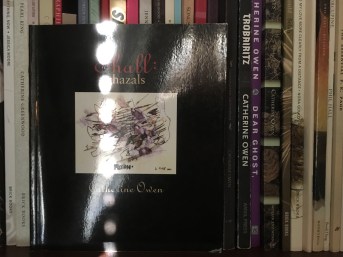
Ghazal wants loss. Ghazal loves a wasteland where the sun has, not quite, set. Ghazal resists adjectives, similes. Ghazal is this, is that. Ghazal demands allusions because ghazal is history, lineage, the remembered face. Ghazal craves the Anglo-Saxon. Ghazal says — repeat after me: love, dark, light, shadows, hands, mouth, lips, seed, tears, scars, flower, seasons, words. Ghazal withholds. Ghazal, a — rebel, an iconoclast, clings with all its might to the Newtonian universe. Ghazal talks to itself. Ghazal has faith in the simple. Ghazal speaks or doesn’t. Ghazal adores a trinity. Ghazal is obsessive (did I say that yet?). Ghazal is obsessive.
–Catherine Owen, from Shall: ghazals, p.18*
*lucky find during one of my trips to Edmonton this summer in The Edmonton Bookstore (one of the best used poetry selections, with a particular focus on Canadian poetry, that I’ve ever seen; one of my favourite poets).
- “Two crows on a globe of light / If I could dip my pen in their wings.”
- Decayed plant matter to peat to lignite to sub-bitumous coal to bitumous coal to anthracite, condensed over millions of years.
- Liquorice, licorice, sweet root.
- Snowfall on Desolation. Night sky over Lightning Creek.
The Missing Field, Jennifer Zilm
October 9, 2018 § Leave a comment
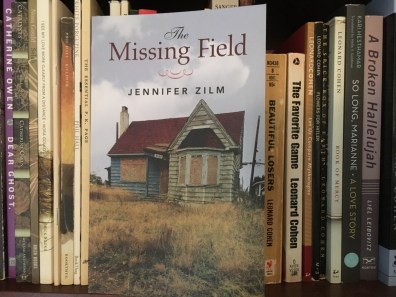
Notes on an accounting of light*
Billy composed a soft inventory,
a calculation of abundance: the way
it appears somehow on every page
yet is still not exhausted. Morning
in my 400 square feet it races
your pulse, raises your property taxes,
balances between cloud and rock, bright
ephemera of winter’s incremental shock.
South and west are skyline, water, Lions
Gate revealed by deciduous sleeping–
birch skeletons illuminated in daytime.
Another factor in this collection’s
assessment, this Library overflow, unending
bibliography–just keep counting.
*from Jennifer Zilm’s The Missing Field (Guernica Editions, 2018)
1972
May 24, 2018 § Leave a comment
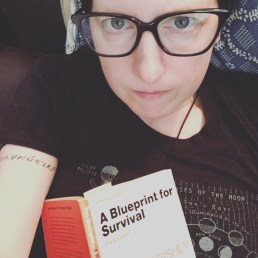
“The principal defect of the industrial way of life with its ethos of expansion is that it is not sustainable. Its termination within the lifetime of someone born today is inevitable—unless it continues to be sustained for a while longer by an entrenched minority at the cost of imposing great suffering on the rest of mankind. We can be certain, however, that sooner or later it will end (only the precise time and circumstances are in doubt), and that it will do so in one of two ways; either against our will, in a succession of famines, epidemics, social crises and wars; or because we want it to—because we wish to create a society which will not impose hardship and cruelty upon our children—in a succession of thoughtful, humane and measured changes.” A Blueprint for Survival, 1972
“radio active”: nuclear-free vancouver on citr radio, 101.9 fm, circa 1989
May 21, 2018 § Leave a comment
Ledi, excerpt–“Ghost”
May 21, 2018 § Leave a comment
I look everywhere for you, in tins and shoeboxes—
There are so many things I cannot find. I look and look.
A reel to reel with your name on the label gummed
to its centre, and a question mark.
Is it you?
I cut up your voice in C-control. Slip
the tape back and forth across the heads
to isolate a word, a breath
caught in the throat.
Meaning poured out of sound.
Slice it out. Tape it back again.
I can’t recall your face, your voice.
Tape your tongue.
How much I missed of you.
Tape your lips.
…
4 June. As she emerged from the ice, towards the very end, they used their fingers to work at the fabric on her body, to ease out her left arm without tearing off her skin. Her clasped hands, so. In this way it felt as if she were coming to life beneath their fingertips.
So I work your body in memory.
These barbaric methods.
…
4 June. They used cupfuls of hot water, to slow the spill of tiny artefacts
…
5 June. But I resist. I approach you sideways. A little at a time, over years. I write a line and score it out. Write another line. Delete it.
You recorded everything: the dopplering train whistle and the insects that woke at dusk. The man at the gas station who taught us how to say Tehachapi. The wind against the sides of the van where we sheltered at night.
You tell me, listen. You take my head in your hands, adjust my earphones, check the levels. A single insect, then a second, begins to sing. A chorus. Electric. This blue light. One group signalling to another across the land.
A train whistle approaches through the dusk. Enters me.
…
Two pieces of string
on her little finger —
remember.
 kim trainor